Consciousness in Practice
🏠 Home · 📚 Reading Notes · 📝 Articles · ℹ️ About
 `
`
★★★★
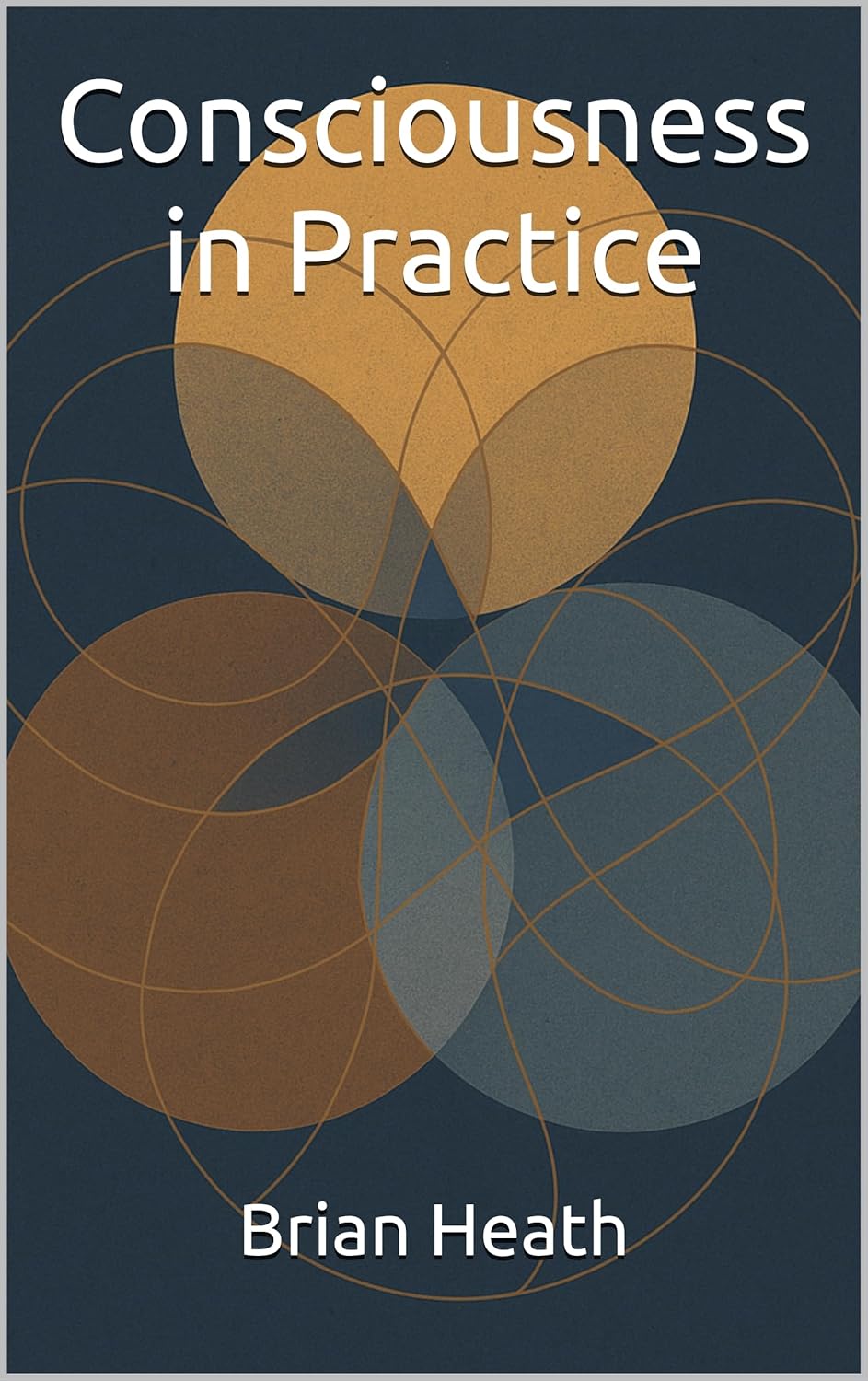
Brian Heath (2025). Consciousness in Practice.
Consciousness in Practice develops the idea of experiential maximalism through a series of dialogues between a philosopher and diverse interlocutors. Consciousness is treated less as a state and more as an ongoing, experimental engagement with other minds, systems, and forms of intelligence.
- 2025-08-15 — p.__ — Initial full read-through and first-pass review.
- One line per thought. Use
p.nfor page marks. Tags: #insight #question #xref
Prompts
- Core idea in one line
- Why it matters / stakes
- Who wants what / conflict
- Evidence or motif you noticed
- One quote to keep (p.n)
- Next connection to your work/life
Core Ideas
At its heart, Consciousness in Practice explores how awareness, creativity, and responsiveness unfold through dialogue. Rather than lecturing, the book immerses the reader in conversations between a philosopher and a diverse cast of thinkers—scientists, artists, business leaders, and seekers. The central idea of experiential maximalism—living consciously and fully in the present moment—emerges organically as these dialogues progress.
This approach feels both intimate and dynamic. The Socratic format invites participation rather than persuasion. Each discussion explores how consciousness operates not as a static condition, but as something that evolves through engagement—with other people, with systems, and even with discomfort. The philosopher’s interlocutors test the theory in practical settings: organizational life, personal crises, ethical dilemmas, and creative pursuits. In doing so, the book suggests that to live consciously is to live experimentally.
One of the most interesting through-lines is the claim that consciousness develops by encountering other intelligences. This insight connects philosophy with real-world implications for collaboration, technology, and even artificial intelligence. The book proposes that our awareness is sharpened and expanded not in isolation but through the recursive interaction between distinct minds.
Observations and Reflections
The choice to begin abruptly with dialogue was bold. It immerses readers immediately in philosophical exchange, but it can also feel disorienting. The term experiential maximalism appears early, yet its meaning is left implicit for several pages. If the goal is to have the reader discover it slowly, the structure works. But narratively, it risks pulling readers out of the story as they try to catch up. I found myself pausing to interpret what was meant rather than staying inside the flow. A small structural adjustment—perhaps a lecture, brief interlude, or even a reflective sidebar early on—could anchor the concept without diluting its mystery.
The dialogue format is engaging but occasionally predictable: challenge → reframing → resolution. Some variation would keep the rhythm fresh—perhaps a conversation that ends unresolved or one where the philosopher is visibly transformed. Between dialogues, short interstitial notes could clarify what shifted in the philosopher’s understanding, creating a stronger sense of intellectual and emotional progression.
I also found myself wanting the philosopher to evolve more noticeably. He remains calm and insightful throughout but rarely uncertain. A few moments of contradiction or humility could deepen the theme of responsiveness that the book advocates. A powerful ending might involve the philosopher confronting a new kind of consciousness—a nonverbal child, for instance, or an AI—forcing him to apply his hard-won insights in an unfamiliar context. That would turn the conclusion into both reflection and test.
Alex and Neurodivergent Representation
Alex is one of the book’s most resonant characters. His depiction of alexithymia—difficulty labeling emotions in real time—feels accurate and compassionate. His assertion that clarity and pattern recognition bring peace is an excellent example of cognition shaped by logic and sensory coherence rather than emotion. Yet his portrayal could go further in illustrating that emotions are not absent but often delayed or unresolved.
As I noted in my own reflections: when a crisis hits, I often prioritize problem-solving over emotion. My experiences mirror Alex’s: emotions are present, but pushed aside until later reflection collapses them into something nameable.
A line like “I might feel cautious, interested, and self-conscious at the same time—there’s no single word for that” would help convey this complexity. It demonstrates that feelings are multi-threaded rather than monolithic, which captures how many neurodivergent individuals experience emotion.
Another strength of Alex’s portrayal is his sensory and social precision. He notices subtle changes in tone and energy—“when someone’s voice changes, or when the room goes quiet after a phone buzzes.” These micro-perceptions not only authenticate his experience but highlight his sensitivity to group dynamics. Expanding this to show how he sometimes feels anxiety on behalf of others would add depth: “When someone breaks a rule, I get anxious. Not because I care about the rule, but because I modeled it. I know what happens next, and my body braces.” This kind of social simulation-based empathy would make Alex’s experience more vivid.
Structural and Thematic Opportunities
Thematically, Alex’s story exemplifies the book’s premise: consciousness refines itself through interaction with other forms of intelligence. His way of perceiving the world is both a challenge and a contribution to the philosopher’s framework. If the philosopher’s arc were slightly more reciprocal—if he learned from Alex as much as he teaches—it would underscore this idea of consciousness as co-creative.
The book’s notion that meditation might simply mean “any practice that increases the fidelity of attention” is worth developing further. It’s a clean, powerful redefinition that aligns with both aesthetic consciousness and modern cognitive science.
Finally, if there’s ever a second book, I’d love to see experiential maximalism applied to groups—organizational systems, collective creativity, neurodivergent–neurotypical collaboration, and social complexity. This next step feels like the natural extension of what you’ve built here: moving from the consciousness of individuals to the consciousness of systems.
Closing
Consciousness in Practice is an ambitious and heartfelt work—philosophy rendered through dialogue rather than argument. Its greatest strength lies in its human details: the hesitations, tensions, and recursive realizations that define real awareness. With a few structural refinements and expanded perspectives, it could become a foundational guide for readers learning not just to think about consciousness, but to live it.
-
“I don’t find the question of how I feel to be very helpful. I have to figure out how things are. If the pattern is clear and true, then I can relax. If not, I keep working.” p.__
-
“If I think about the way I pursue my interests as a kind of meditation, then I’ve been meditating all my life.” p.__
-
“Perhaps attention, not silence, is the essence of meditation. Yours is precise.” p.__
-
Source card: Zotero source card
-
Open in Zotero: zotero://select/items/@heathConsciousnessPractice2025
-
External:
-
Hub: Reading Notes (Hub)